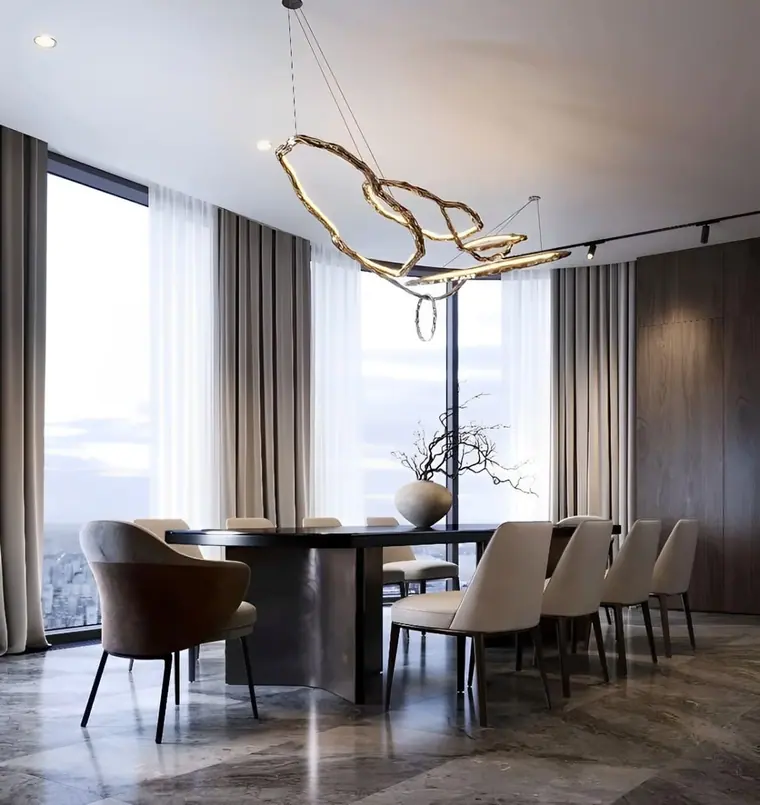
Silk Drapery and the Sun: How to Keep the Loveliest Cloth Safe
Silk drapery is the loveliest cloth at a window and the first to perish in the sun. How dupioni, taffeta and satin differ, and how lining and shade save them.

Silk drapery is the most beautiful thing that can be hung at a window, and it is the first to perish there. No other cloth has its luster or falls into such folds, and none is so quickly undone by the sun. We touched upon it in our guide to natural fiber drapery. This entry takes silk alone: what it is, why the light harms it, which windows suit it, and how lining, interlining and a little management of the sun allow it to be enjoyed for many years in the formal rooms of Beverly Hills, Holmby Hills and San Marino.
What makes silk unlike any other drapery fabric?
Silk is spun by the silkworm, the caterpillar of the moth Bombyx mori, which is reared upon mulberry leaves. Each cocoon is a single unbroken filament, of which some two to three thousand feet can be reeled off and used. Silk alone among the natural fibers is one continuous thread, and that smoothness is where its luster comes from.
The filament is a protein, called fibroin, and in that respect silk is nearer to wool than to linen or cotton. It takes dye in deep and brilliant colors, and it hangs with a weight and a liveliness that the eye knows at once.
Dupioni silk, silk taffeta or satin: which is which?
The three names most often met in drapery describe the yarn or the weave, and each hangs in its own way.
- Dupioni. Woven from the uneven thread of double cocoons, which two silkworms have spun together. The thick places show as slubs running across the cloth. It is crisp, and it holds a pleat well.
- Taffeta. A fine, tight plain weave of smooth yarn, with no slubs. It is crisp and light, it stands in sculpted folds, and it rustles as it moves.
- Satin. A weave in which the threads float across the surface and throw back the light. It is the most lustrous of the three and the most fluid, and it marks the most easily.
All three are at their best with a formal heading, such as a pinch pleat, and with generous fullness, since silk shows its quality in the depth of its folds.

Why does the sun rot silk drapes?
Ultraviolet light, with the help of the oxygen in the air, breaks down the protein of which silk is made. The cloth yellows, grows brittle and loses its strength, and it does so faster than cotton or wool. The harm is cumulative and it cannot be reversed. It is also largely unseen. A panel may look perfectly well and then split along the folds that faced the glass.
Glass alone is small protection. Ordinary window glass stops most of the UVB but lets through much of the UVA. Unlined silk at a strong southern or western exposure can fail within a few years. Properly made and properly placed, the same cloth can serve for well over a decade.
How do lining and interlining protect silk curtains?
We do not hang silk unlined. The lining, usually a closely woven cotton sateen, hangs on the window side and takes the light that would otherwise fall upon the face cloth. Between the two goes the interlining, a soft cotton flannel. It adds a further barrier to the light, and it lends a thin cloth the body it lacks, so that interlined silk falls in deep, rounded folds and not in sharp creases.
In a bedroom a blackout lining gives the fullest protection of all, since almost no light passes through it to the silk. The leading edges, where the two panels meet, and the hems are the places where the face cloth turns back toward the glass, and they are generally the first to show harm. The making is described in our entry on lining, interlining and fullness.
Which windows should silk avoid?
The exposure matters more than anything else. North facing rooms receive little direct sun and are the kindest to silk. East facing rooms take the gentler sun of the morning. South and west are the hard exposures in Los Angeles: the south in winter, when the sun is low and reaches deep into the room, and the west for the heat of the afternoon.
At those windows silk needs help. A sheer hung between the silk and the glass filters the light all day. A solar shade concealed at the head of the window may be lowered through the bright hours and raised in the evening. A clear film upon the glass stops about 99 percent of the ultraviolet, and we arrange it through an outside installer. Silk also shows water marks, and it is best kept from steamy baths and from the ocean air.

When are faux silk drapes the wiser choice?
Sometimes the honest advice is not to use silk at all. Polyester is now woven to resemble dupioni and taffeta very closely, slubs and luster included, and it is far steadier in the sun. For a west facing window that cannot be shaded, or for a house near the ocean, we advise it and say so plainly. These cloths are described in our guide to performance drapery fabrics.
Where does silk belong in Beverly Hills, Holmby Hills and San Marino?
For silk drapery in Beverly Hills the natural home is the Flats, where the Spanish, Regency and Georgian houses have tall ceilings and rooms made for entertaining. Interlined silk on a rod scaled to the room suits a drawing room or a dining room there very well. The glass houses of Trousdale Estates are another matter, and there we should sooner hang a faux silk or a sheer. In Holmby Hills the estates along Carolwood Drive and Mapleton Drive have formal rooms of great height, and silk is at home in them, with shades concealed in the ceiling to manage the sun.
Silk drapery in San Marino belongs to the Georgian, Colonial and Mediterranean houses around the Huntington, with hand pleated headings and rods suited to the period of the house. The San Gabriel Valley sun is strong, however, and at southern and western windows a lining, a sheer and a discreet shade are not to be dispensed with.
If you are considering custom drapery in silk, we should be glad to bring the fabrics to the house. Diana Mendez, who leads the firm and is a textile expert, advises on the cloth, the linings and the protection each room requires. Please request a consultation and she or one of her designers will be in touch to arrange it.
Questions and answers
How long does silk drapery last?
That depends chiefly on the sun. Unlined silk at a strong southern or western window can fail within a few years. Lined and interlined silk, kept from direct sun by a sheer, a shade or film upon the glass, can reasonably give well over a decade of service.
Should silk curtains always be lined?
Yes. We do not hang silk without a lining, and in nearly every case we add an interlining as well. The lining takes the light that would otherwise fall on the silk, and the interlining gives a thin cloth body and a deeper fold.
Can silk drapery be used at a south or west facing window?
It can, with help. We place a sheer or a solar shade between the silk and the glass, and lower the shade through the bright hours. Where the window cannot be shaded, a faux silk is the wiser choice.
What is the difference between dupioni silk and silk taffeta?
Both are crisp plain weaves. Dupioni silk is woven from the uneven thread of double cocoons, so slubs run across the cloth. Silk taffeta is woven from smooth yarn, has an even surface and rustles as it moves.
Would you like advice on your own windows?
Request a Quote →