Roman Shades and Drapery for Brentwood's Garden Rooms
The Roman shades Brentwood homes want: flat or relaxed, lined for gray mornings, mounted clear of the garden view and paired with drapery.
Of all the places where we make Roman shades Brentwood suits them best. It is a neighborhood of gardens, and its rooms were built to look into them: the breakfast room, the study, the window above the sink, the seat beneath a bedroom window. A Roman shade gives such a window the softness of cloth and takes up next to no room. This guide sets out how we choose between the flat and the relaxed style, how the gray mornings of the coast bear upon the lining, where the shade should be mounted and how it is paired with drapery, in Brentwood and in Pacific Palisades beside it.
Why do Roman shades in Brentwood suit the houses so well?
Because the houses are traditional and the windows are many and various. Brentwood Park was laid out in 1906, and its houses, built for the most part between the 1920s and the 1950s, are Colonial, Tudor and Spanish in manner. South of it runs San Vicente Boulevard, whose median of coral trees has been a city monument since 1976. In Sullivan Canyon, Cliff May, who made the California ranch house famous, laid out Riviera Ranch at the close of the 1930s, and the low houses there open straight onto their grounds.
What these houses share is the small window that matters. Full drapery would crowd a desk, a banquette or a window seat, and it has no business above a sink. A Roman shade lies within the window or just above it, rises in horizontal folds and leaves the furniture alone.
Flat Roman shades or relaxed Roman shades?
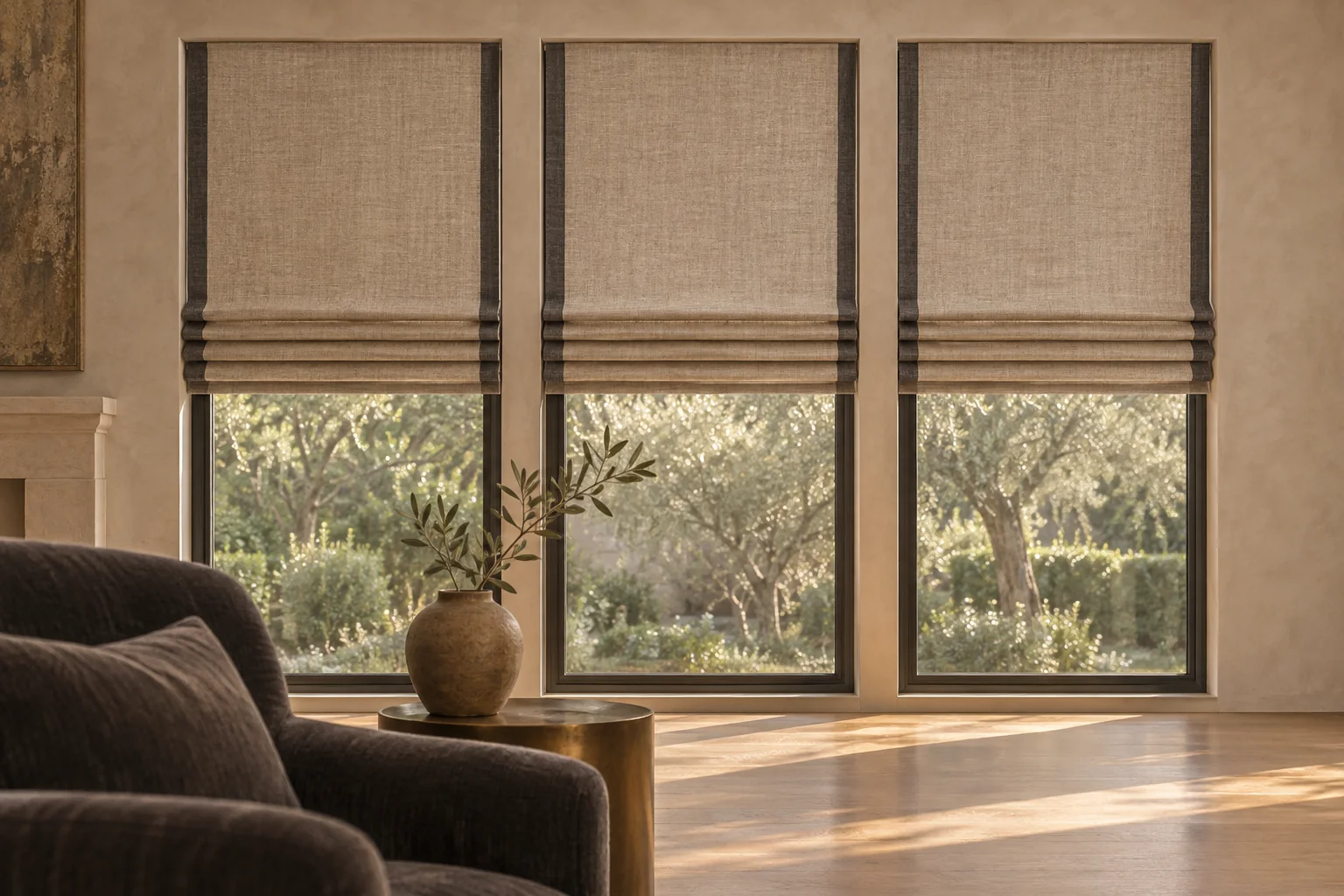
The difference lies in what is sewn into the back. A flat Roman shade has slender ribs set across it at intervals and a bar in the hem. Lowered, it is a plain panel with a straight lower edge, which shows a stripe or a print to advantage. Raised, it gathers in even folds and needs no attention, so it may be worked twice a day for years. It is also the style that takes a motor best.
A relaxed Roman shade has no bar in the hem. The cords draw up the sides and the middle falls in a soft curve, which is charming in a plain linen. The folds want arranging by hand after the shade is moved. The curve deepens with the width, so it is happiest on a window of modest size. And the curved hem leaves a little light at the lower corners, so it is no shade for a room that must be dark.
- Choose the flat style for a kitchen, a study or a bedroom, for any shade that is raised and lowered daily, for a patterned cloth and for a row of windows whose hems should stand in line.
- Choose the relaxed style for a window seat, a breakfast room or a powder room, in a plain soft cloth, where the shade will rest at one height for most of the day.
- Divide a wide window. Most furnishing cloth is woven about fifty four inches wide, and a wider shade must be seamed, so two or three shades that follow the mullions look better than one.
How do marine layer mornings change the choice?
In late spring and early summer the marine layer brings low cloud over the coast by night, and it commonly clears by late morning or early afternoon. A room there has two lights in one day, a soft gray one and a bright one, and the shade must serve both.
For the day rooms we therefore advise a pale cloth with a light filtering lining, so that a lowered shade glows on a gray morning and does not darken the room. A blackout lining is kept for the bedrooms, where the shade is best mounted outside the frame to cover the edges, as described under blackout shades.
Should a Roman shade be mounted inside the frame or above it?
A Roman shade does not vanish when it is raised. The folds gather into a stack at the head of the window, commonly eight to twelve inches deep on a tall one. Inside the frame, that stack covers the top of the glass, and in a garden room the top of the glass is the treetops. Where the wall allows, we mount the shade above the casing, so that the stack rests upon the wall and the glass is left clear. Where the casings are too good to cover, or drapery is to hang over all, the shade goes inside, and we say plainly how much glass it will take.
How are Roman shades with drapery best arranged?
The shade sits within the frame and does the daily work of light and privacy. The panels hang from a rod outside it and soften the room, and they need be drawn only at night. One of the two should be plain. A printed shade between plain panels is lively, and a plain shade between printed panels is calmer; our entry on cotton drapery explains why the prints are nearly all cotton. Both are lined alike, so that the street sees one window.
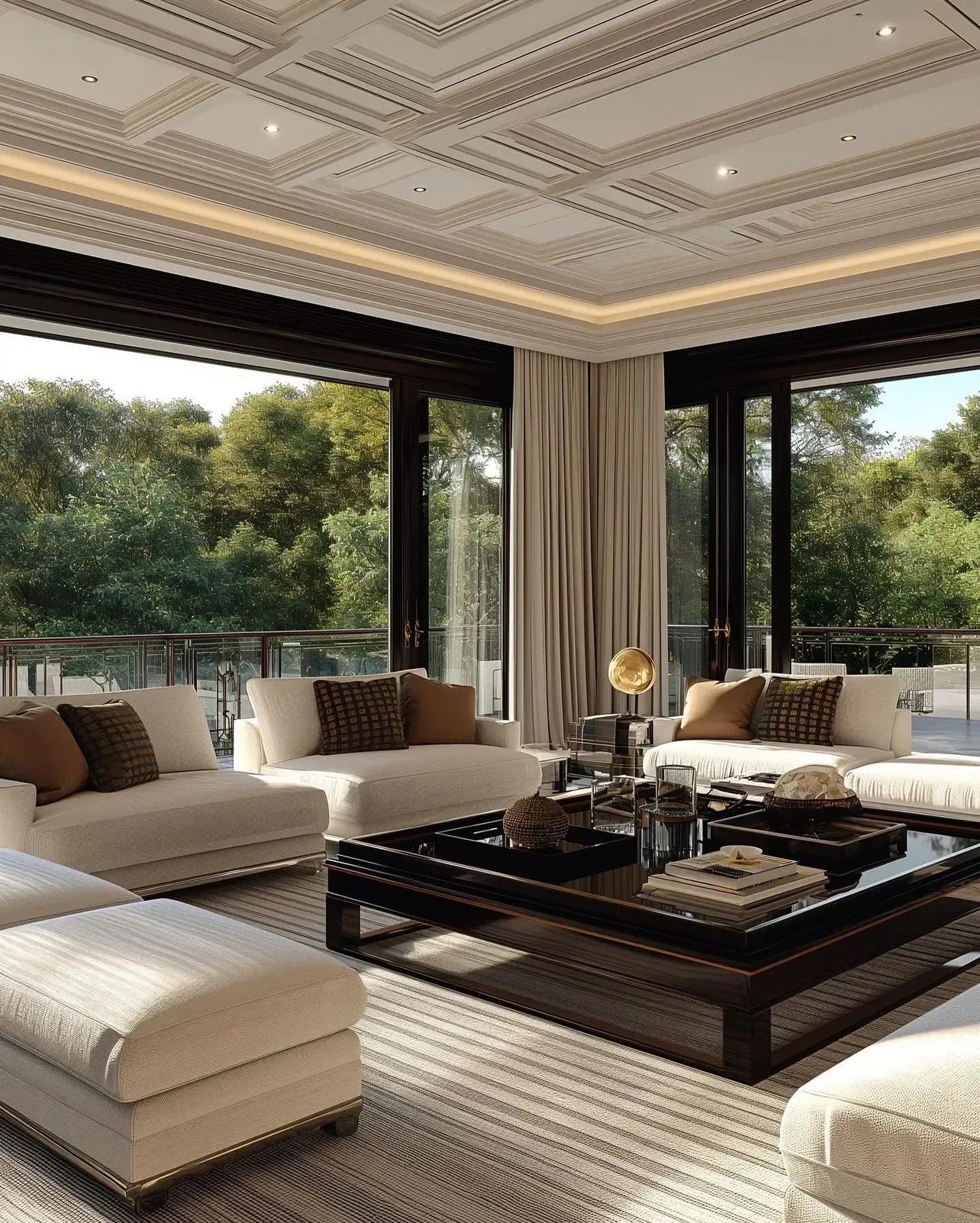
The same thinking joins a whole room. Where French doors stand between two windows, custom drapery dresses the doors, drawn clear of the glass by day, and custom Roman shades in the same cloth dress the windows.
What of Roman shades in Pacific Palisades?
Pacific Palisades was founded in 1922 by Methodists, upon the bluffs above the sea, and its houses are turned to the ocean and the canyons. The light is brilliant and the western exposure long. On the large glass that faces the water a solar shade is the first layer, since it cuts the glare and keeps the horizon. Roman shades belong at the smaller windows of bedrooms, baths, kitchens and studies. Many families there are rebuilding, and a new house allows power to be brought to every window from the first drawing.
For Roman shades Brentwood and the Palisades are among the places we know best, and we are glad to bring samples of custom shades and cloth to the house. Diana Mendez, who leads the firm and is a textile expert, advises on the fabrics and the linings. Please request a consultation and she or one of her designers will be in touch to arrange it.
Questions and answers
Which is better, a flat or a relaxed Roman shade?
A flat Roman shade is the better choice for a window that is used every day. It rises in even folds, shows a pattern well and may be motorized. A relaxed Roman shade has a softly curved hem and suits a smaller window where the shade is seldom moved.
How much of the window does a Roman shade cover when it is raised?
The raised folds form a stack at the top, commonly eight to twelve inches deep. Mounted inside the frame, the stack covers the top of the glass. Mounted above the frame, it rests on the wall and leaves the glass clear.
Can Roman shades and drapery be used at the same window?
Yes, and it is one of the handsomest arrangements. The shade sits inside the frame for light and privacy, and drapery panels hang at each side from a rod. We advise one plain cloth and one patterned, lined alike.
Do Roman shades still have cords?
Not free hanging ones. The industry safety standard in force since June 2024 no longer permits them on made to measure shades. A Roman shade is now worked by a cordless lift, a tensioned loop or a motor, which is safer where there are children.
Would you like advice on your own windows?
Request a Quote →